We usually associate breakthroughs in the history of heavy transport with Cugnot's steam-powered road vehicle , Daimler's first truck in 1896, or the American highway boom of the 1950s. However, the foundations for these technologies were laid centuries earlier – in the brilliant mind of a Renaissance creator whose visions were centuries ahead of his time.
Leonardo da Vinci's famous self-propelled cart (carro semovente) is most often dated to the years 1478–1485 and is one of the earliest known machine designs in which one can see the seeds of thinking about automatic movement, route programming and mechanical vehicle control.
Imagine a world where the primary source of traction comes from the muscles of humans and animals, and the pinnacle of practical logistics remains a well-designed horse-drawn cart. In such a setting, Leonardo sketches a device that could move independently, without a horse, ox, or human pulling it by the shaft.
Although we commonly associate him with painting, Leonardo often thought and worked like a designer: he designed war machines, hydraulic devices, bridges, stage mechanisms, tools, and automata.
His self-propelled cart, according to modern interpretations, may have served as a stage set or a courtly show machine, used during ceremonies and performances. It didn't transport goods through cities and roads, but it demonstrated something crucial: that a vehicle could be set in motion, steered, and stopped by its own mechanism.
The invention likely remained a design on paper. There is no certain evidence that Leonardo built a working example, and functional models and reconstructions have only been created in modern times.
Leonardo's greatest challenge was the lack of an engine as we understand it. Internal combustion engines, traction batteries, and hydraulic systems that could power a vehicle for extended periods did not yet exist. Da Vinci solved this problem in a remarkably ingenious way, harnessing mechanical energy stored in springs.
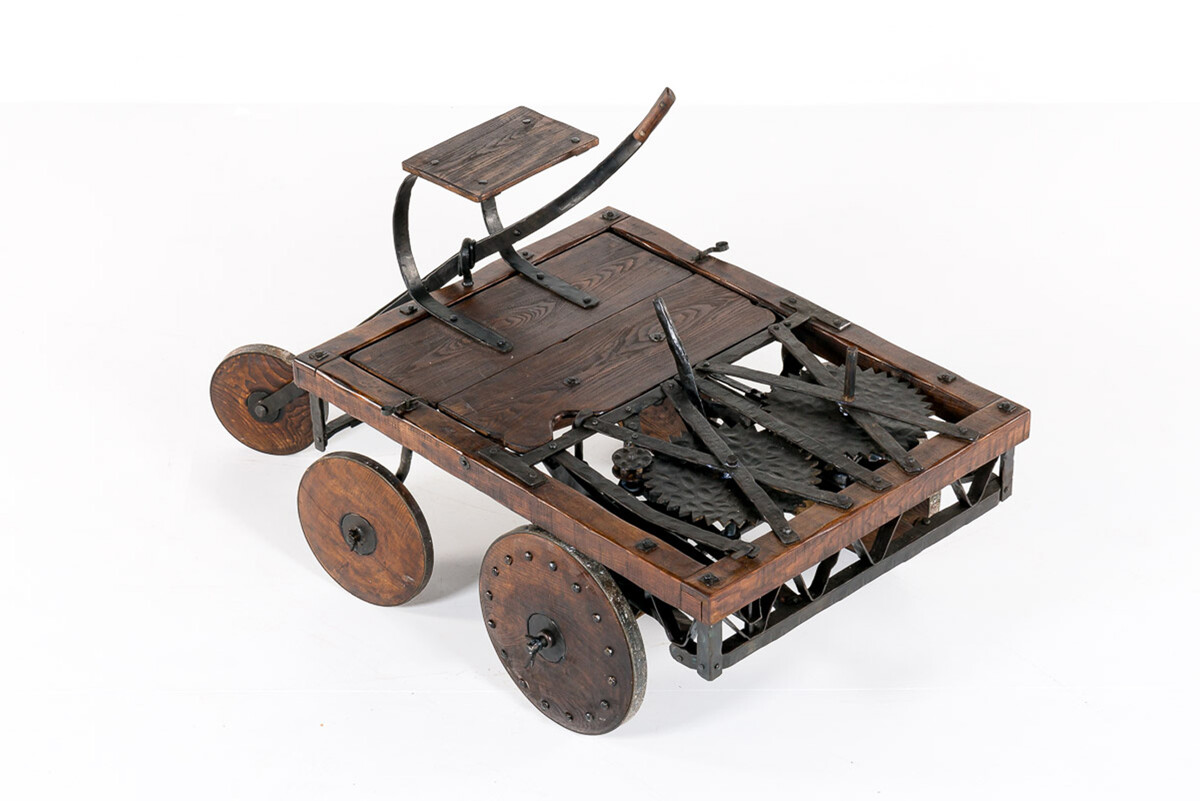
According to modern reconstructions, the trolley was powered by spiral springs hidden in drums. The principle was simple in concept, but difficult to implement. The springs had to be tensioned first, and then the energy stored within them released. This energy was transmitted to the vehicle's wheels via a system of gears.
The problem with spring drives, however, is that the force exerted by the spring varies over time. Initially, it's large, then gradually decreases. Leonardo attempted to counteract this by incorporating a mechanism that regulated the gear's speed. This solution can be compared to the mechanisms found in ancient clocks – it didn't so much control torque in the modern sense, but rather limited the sudden release of energy and helped maintain a more predictable motion.
We are not dealing here with just a simple spring-powered vehicle - it is a mechanical system in which the drive, control, start lock and motion regulation have been designed as a whole.
The most modern element of the design was the steering system. According to modern reconstructions, Leonardo's carriage allowed for earlier adjustment of the trajectory. Steering was performed using a system of gears, pins, and cam-like elements.
The operator preparing the device could adjust the mechanism to make the vehicle travel straight or make planned turns. Leonardo's cart is sometimes described today as one of the earliest examples of a programmable device.
The design also incorporated a mechanism similar to a primitive differential. This allowed the wheels to operate independently during steering, reducing slippage and improving smoothness.
The launch occurred after releasing the mechanism lock that previously held the springs under tension. Once unlocked, the vehicle would move and complete its planned driving cycle.
 source: https://mostre.museogalileo.it
The self-propelled cart was just one of many examples of Leonardo's extraordinary technical imagination. Da Vinci embodied the Renaissance ideal of artist, explorer, designer, and observer of nature.
By analyzing bird flight, he designed flying machines, including the famous air screw, which can be considered a very early concept of a rotary engine. His dissections of cadavers and studies of human anatomy resulted in sketches that remain astonishingly precise to this day.
Muscles, joints, proportions, vectors of forces and tensions - for Leonardo, human biomechanics and machine kinematics were governed by the same universal law.
His artistic legacy remains a cornerstone of European culture—from the Mona Lisa to the Last Supper to the Lady with an Ermine . But equally fascinating are his notebooks and codices, including the Codex Atlanticus . In them, we find designs for war machines, bridges, hydraulic devices, dredgers, stage mechanisms, and vehicles, demonstrating Leonardo's consistent quest to understand motion.
Leonardo created a design that demonstrated that vehicle motion could be represented by the geometry of gears, and that the machine could execute a pre-prepared sequence of actions. He demonstrated that transportation, even if still in miniature form, could be accomplished without horses, oxen, or human traction.
Leonardo's self-propelled cart still captures the imagination as one of the most magnificent Renaissance proofs that the dream of intelligent machine movement was born long before the era of internal combustion engines, asphalt highways, and on-board computers. This dream began with a spring, a gear, and a man who could see a mathematical algorithm in the drawing of a bird's wings and the entanglement of human muscles.
Autos Editorial Team
Reconstruction: Museo del Sidecar Cingoli (Macerata)
Materials: wood (oak, poplar, elm, fir), wrought iron, natural glues, beeswax.
source: https://mostre.museogalileo.it